| フォーマット | CDアルバム |
| 発売日 | 2005年06月27日 |
| 国内/輸入 | 輸入 |
| レーベル | Silva Screen |
| 構成数 | 4 |
| パッケージ仕様 | ボックス |
| 規格品番 | SILCD1170 |
| SKU | 738572117023 |
構成数 : 4枚
合計収録時間 : 04:51:37
Personnel: Bronagh Mullan (vocals); Lenka Pecharova (soprano).
Recording information: Barrandov Studios - Smecky Soundstage, Prague ; Whitfie.
Editor: Gareth Williams.
Arrangers: William Walton ; Steven R. Bernstein; Elmer Bernstein ; Erich Wolfgang Korngold; Franz Waxman ; Gareth Williams; Lawrence Ashmore; Christopher Tin; Mark McGurty; James Horner; Jerry Goldsmith; John Debney; Alex North; Mike Townend; Arthur Freed; Basil Poledouris; Philip Lane; Carl Orff; Nic Raine; Miklos Rozsa; Max Steiner ; Christopher Palmer.
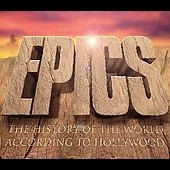
Reynold DaSilva's Silva Screen Records has built up quite a library of music by having the City of Prague Philharmonic Orchestra (which presumably works cheaper than a name orchestra from Western Europe or the U.S. would) create new recordings of film scores, enabling the label to then recycle the material into thematic compilations such as this one devoted to music from "epic" motion pictures. The subtitle, "The History of the World According to Hollywood," calls to mind the books and History Channel shows devoted to examining how historical movies differ from history as historians know it. But no such analysis is attempted here. (In fact, there are no liner notes.) Instead, the idea is to present music from big-budget movies about the past, in roughly chronological order, that is, chronological order of history itself, not the movies, so that the first track on the first disc is a suite from Mario Nascimbene's score for the 1966 film One Million Years B.C., best remembered for Raquel Welch cavorting in a furry bikini, and the last track on the fourth disc, arriving more than four-and-three-quarters-hours later, is Ernest Gold's overture from the 1960 film Exodus, a dramatization of the struggles leading to the establishment of Israel in the mid-20th century. In between, as subheads helpfully note, we get music associated with films depicting "The Ancient World" (quite a few of those), "The Fall of Rome," "Biblical Epics," "Medieval Europe," "Pirates & Swashbucklers" (how did they get in here?), "Kings & Queens," "Heroes," "The New Worlds," and "The British Empire/The Orient." This organization makes sense only on paper, of course. On disc, the collection mixes up scores written between 1935 (Erich Wolfgang Korngold's main title from Captain Blood) and 2004 (Vangelis' "Across the Mountains" and "Eternal Alexander" from Alexander, James Horner's "Remember" from Troy, John Debney's "Resurrection" from The Passion of the Christ), which means the music was written for epics of very different kinds. As a general statement, epics tend to bring out big orchestral effects from composers: grand themes, martial rhythms, and choruses wordlessly emoting or singing in Latin. (Either the Prague's chorus or the Crouch End Festival Chorus obliges where necessary.) But especially the more recent works by composers such as Horner and Hans Zimmer (Gladiator, The Last Samurai) can be more subtle. Perhaps appropriately, this epical music is all over the map.
読み込み中にエラーが発生しました。
画面をリロードして、再読み込みしてください。