Pitchfork - "[I]t was a massively ambitious statement album, a collection of covers and originals that documented the collapse of Hayes' marriage. It was an enormous success..."
Rolling Stone - 4 stars out of 5 -- "[Hayes] mourns a collapsed marriage across two discs that seem to spin in slow motion as Hayes flexes masculine strength through vulnerability."
Living Blues - "BLACK MOSES is an emotionally lush set....BLACK MOSES is probably most closely associated with its lead single, Haye's stirring version of the Jackson 5's 'Never Can Say Goodbye'..."
Record Collector - 5 stars out of 5 -- "Hayes' most heartbreakingly intimate, emotionally sincere and brave release."
Spin - "[Hayes] played the prophet of heartbreak, delivering two platters of wistful covers wrapped in symphonic strings..."
Clash - "This album's spiraling grooves and lush sonic landscapes have inspired everyone from hip hop producers to Portishead..."
Uncut - 3 stars out of 5 -- "What he brought to the '70s party, apart from sheer chutzpah...was sonic nous, the ability to play an entire studio and to integrate technical innovations like fuzztone and wah-wah guitars."
Pitchfork (Website) - "[I]t was a massively ambitious statement album, a collection of covers and originals that documented the collapse of Hayes' marriage. It was an enormous success..."
Rovi
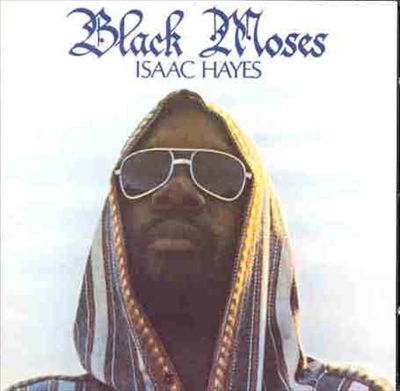
Isaac Hayes is nothing if not ambitious, and this double-disc collection is a case in point. Released the same year as the breakthrough SHAFT soundtrack, 1971's BLACK MOSES melds Hayes's superior skills as an architect of progressive soul sounds with his talent as a song interpreter. Except for his smooth, boudoir-savvy "raps"--there are three within the set, acting as intros to songs about love and devotion--Hayes's own songwriting energies take a backseat to tunes by some of the preeminent pop songwriters of the '70s.
Clifton Davis's magnificent "Never Can Say Goodbye" is given loving--and arguably definitive--treatment here. In its rich majesty, Hayes's reading of Kris Kristofferson's "For the Good Times" provides an intriguing counterpart to Al Green's spare 1972 version of the same tune. Two Bacharach-David songs, "I'll Never Fall in Love Again" and "Close to You", sound not at all misplaced beside two Curtis Mayfield numbers. That's because Hayes (and his collaborator Johnny Allen) re-imagined the songs into new versions via lush, orchestral charts, so that each tune bears the team's stamp indelibly. Though full of covers, BLACK MOSES is an Isaac Hayes record through and through, and in its continuity and smarts, one of his finest.|
Rovi
The sheer tenacity -- albeit undeniably fitting -- of this double-disc set has made Black Moses (1971) one of Isaac Hayes' most revered and best-known works. The multi-instrumental singer/songwriter and producer had been a central figure in the Memphis soul music revolution of the mid-'60s. Along with Booker T. & the MG's, Hayes wrote and performed on more Stax sides than any other single artist. By the time of this release -- his fifth overall, and first two-record set -- Hayes had firmly established himself as a progressive soul artist. His stretched-out and well-developed R&B jams, as well as his husky-voiced sexy spoken "raps," became key components in his signature sound. Black Moses not only incorporates those leitmotifs, but also reaffirms Hayes abilities as an unmistakably original arranger. Although a majority of the album consists of cover material, all the scores have been reconfigured and adapted in such a fundamental way that, for some listeners, these renditions serve as definitive. This is certainly true of the extended reworkings of Jerry Butler's "Brand New Me" and Esther Phillips' "You're Love Is So Doggone Good" -- both of which are prefaced by the spoken prelude to coitus found in each respective installment of "Ike's Rap." The pair of Curtis Mayfield tunes -- "Man's Temptation" and "Need to Belong to Someone" -- are also worth noting for the layers of tastefully scored orchestration -- from both Hayes and his longtime associate Johnny Allen. The pair's efforts remain fresh and discerning, rather than the dated ersatz strings and horn sections that imitators were glutting the soul and pop charts and airwaves with in the mid-'70s. Hayes' own composition, "Good Love," recalls the upbeat and jive talkin' "Hyperbolicsyllabicsesquedalymistic" from Hot Buttered Soul (1969), adding some spicy and sexy double-entendre in the chorus. ~ Lindsay Planer
Rovi