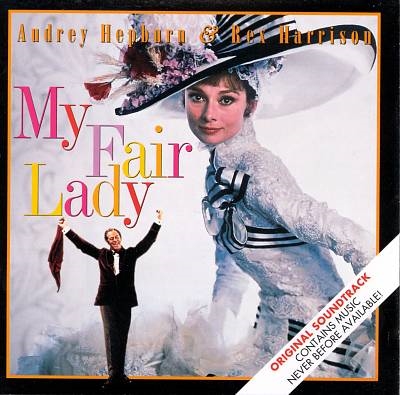
Entertainment Weekly (10/12/01, p.30) - Ranked #18 in EW's "100 Best Movie Soundtracks" - "...Among the most lovely of soundtracks..."
Rovi
Inevitably, the original soundtrack to My Fair Lady is remembered, like the film, for the absence of Julie Andrews, who starred in the Broadway and London stage productions, but was deemed, at least at the time when the casting decision had to be made, not enough of a star to carry the movie. (Embarrassingly, by the time the movie opened, Mary Poppins had made her more than enough of a star to do so.) Instead, Audrey Hepburn stepped into the role of the pre-World War I London flower girl Eliza Doolittle, who aspires to a better accent and the social advantages that will come with it. Ironically, Hepburn's voice was dubbed by Marni Nixon when it came to singing. (Nixon was an accomplished Hollywood voice ghost, having previously sung for Deborah Kerr in The King and I and Natalie Wood in West Side Story, among other assignments.) Rex Harrison re-created his stage role as the elocutionist, Professor Henry Higgins (he had also appeared in the film adaptation of George Bernard Shaw's play Pygmalion, the source for My Fair Lady), as did Stanley Holloway, as Eliza's flamboyant Cockney father. It was good that Harrison and Holloway got to immortalize their performances on film, but since both were making their third recordings of the score, they didn't have much to add. Nixon (no doubt with bits of Hepburn here and there) was fine, but the composite performance lacked the flair that Andrews would have given it. The result was an acceptable recording that did not surpass the Broadway or London cast albums. [The 1994 CD reissue adds a number of choral and orchestral interludes, as well as reprises of a few songs.]
Rovi
Inevitably, the original soundtrack to My Fair Lady is remembered, like the film, for the absence of Julie Andrews, who starred in the Broadway and London stage productions, but was deemed, at least at the time when the casting decision had to be made, not enough of a star to carry the movie. (Embarrassingly, by the time the movie opened, Mary Poppins had made her more than enough of a star to do so.) Instead, Audrey Hepburn stepped into the role of the pre-World War I London flower girl Eliza Doolittle, who aspires to a better accent and the social advantages that will come with it. Ironically, Hepburn's voice was dubbed by Marni Nixon when it came to singing. (Nixon was an accomplished Hollywood voice ghost, having previously sung for Deborah Kerr in The King and I and Natalie Wood in West Side Story, among other assignments.) Rex Harrison re-created his stage role as the elocutionist, Professor Henry Higgins (he had also appeared in the film adaptation of George Bernard Shaw's play Pygmalion, the source for My Fair Lady), as did Stanley Holloway, as Eliza's flamboyant Cockney father. It was good that Harrison and Holloway got to immortalize their performances on film, but since both were making their third recordings of the score, they didn't have much to add. Nixon (no doubt with bits of Hepburn here and there) was fine, but the composite performance lacked the flair that Andrews would have given it. The result was an acceptable recording that did not surpass the Broadway or London cast albums. [The 1994 CD reissue adds a number of choral and orchestral interludes, as well as reprises of a few songs.] ~ William Ruhlmann
Rovi
『マイ・フェア・レディ』(1964)
サウンドトラック
作詞 アラン・ジェイ・ラーナー
作曲 フレデリック・ロウ
監督 ジョージ・キューカー
主演 レックス・ハリソン、オードリー・ヘップバーン
「ブリガドーン」「キャメロット」「恋の手ほどき」
などの名作を残すラーナー/ロウ・チームによる
ミュージカル映画の傑作。「踊り明かそう」を
初めとして、楽しい歌の数々は、3大ミュージカル映画
(あと2つは「ウエストサイド物語」と「サウンド・オブ・
ミュージック」)として燦然と輝いています。
(C)馬場敏裕
タワーレコード(2004/10/06)