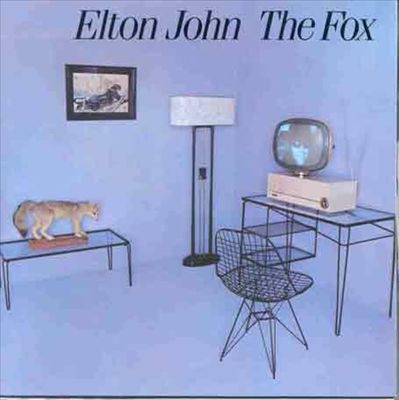
Like David Bowie, Elton John made himself over in the 1980s from his over-the-top glam-rocker image to one that was less theatrical, more refined, even slick. The music was affected as well, as the '80s saw Elton flirting with disco, new wave, and several lyricists. He also flirted with danger, dropping some of the more obvious trappings of the Me Decade (the big glasses, for example) but remaining perilously close to its hedonistic excesses.
His principal songwriting partners on THE FOX were the sometimes-estranged Bernie Taupin, and Gary Osborne. Production duties fell to Chris Thomas, who produced successful records for cutting-edge bands of the moment like the Pretenders. There's a bit more piano on this record than on some previous releases, such as on the opener, "Breaking Down the Barriers", which barrels forward on the strength of Elton's propulsive keyboard, and "Heart in the Right Place", which has the bite of some of Elton's early angry songs. The disco-tinged "Nobody Wins" did moderately well as a single, but "Chloe" is the stand-out track, a classic Elton ballad which should have been a big hit.|
Rovi
The early '80s were not a particularly focused time in Elton John's career. The Fox (1981) is a reflection of the tentative regrouping that began on his previous effort, 21 at 33 (1979). In fact, a third of the material was left over from the same August 1979 sessions. This results in dithering musical styles and ultimately yields an uneven and at times somewhat dated sound. The reunion with Bernie Taupin (lyrics) that commenced on 21 at 33 is once again sparsely tapped. He contributes the tepid "Heels of the Wind" as well as "Just Like Belgium," which foreshadows the pair's future lightweight efforts such as "Nikita." Slightly more promising, however, is the midtempo rocker "Fascist Faces" -- which may well be a nod to David Bowie's infamous "Britain could benefit from a fascist leader" statement. The album's introspective title track instantly recalls the slightly bittersweet "Curtains" coda from Captain Fantastic and the Brown Dirt Cowboys (1975). Gary Osborne and Elton John's collaborations were beginning to yield some impressive results, including "Heart in the Right Place" -- which could easily have been a follow-up to the slinky Caribou (1974) track "Stinker." The tender "Chloe" conclusion to the "Carla/Etude/Fanfare" medley became one of two tracks extracted as singles. The other, "Nobody Wins," sports a Euro-beat flavor and was adapted from a French techno-pop hit by Osborne and Jean-Paul Dreau. According to John, the dark and noir "Elton's Song" remains a favorite, and he very occasionally revives it for live performances. Although The Fox isn't a grand slam, it isn't exactly a bunt either. However, the incremental momentum would continue on the subsequent long-player, Jump Up! (1982), before culminating on his '80s breakthrough, Too Low for Zero (1983). ~ Lindsay Planer
Rovi