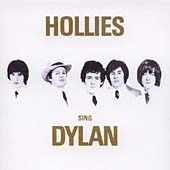
This is the most controversial album in the Hollies' entire output. Co-founder Graham Nash claimed he quit over the decision to record it, and critics hated it. And on its face, the divisions that existed (and still exist) over this album are all understandable -- even though they had been doing some of his songs in concert, the Hollies' distinctive high harmony singing and pop-oriented British beat sound were not a seemingly natural fit with Bob Dylan's work, with its mix of earthy sensibilities and raw musicality, not to mention words that were perceived as very important, even profound; an album of, say, Burt Bacharach songs (and this is not meant to be a swipe at Bacharach or lyricist Hal David) would have seemed a slightly better fit to many listeners, and certainly to most critics (for whom the Hollies doing an album of Dylan songs was only a step removed from Herman's Hermits doing one). The fact is, with one possible exception, the dozen songs here are not presented in anything close to their ideal forms -- and a few even miss their ideal Hollies form. Yet the album has virtues that may grow on you. Allan Clarke's powerful lead vocals are their own justification, almost everywhere here except for on his overly dramatic rendition of "Blowin' in the Wind," which is also overproduced, with a too-active brass section punctuating the verses and a string section that sounds like it's trying for a fade-out similar to that of the Beatles' "All You Need Is Love." And the soaring harmonies of Tony Hicks and new member Terry Sylvester, along with Hicks' myriad guitar contributions to the album; and the group's decision to draw from some of the then newer and also some less well-traveled corners of Dylan's songbook combine to make this a more interesting record than it might otherwise be.
The songs range from then new compositions such as "This Wheel's on Fire" to earlier, relatively obscure pieces like "When the Ship Comes In" (which would have been better known to folkies at the time). The latter is highlighted by Clarke's forceful singing, solo on the first verse with the other joining in subtly on the second, and a lively contribution on banjo by Hicks, which eventually blooms into a cascade of stringed instruments (with what sounds like a harp buried deep in the mix); Clarke's dramatic lead works there, and on "I Shall Be Released," which stands at the opposite pole, nicely stripped down and played on acoustic guitars with soaring harmonies, with an understated embellishment of what sound like marimbas, topped by a steel guitar break played by Alan Parker. The overblown, orchestrated version of "Blowin' in the Wind" (in an arrangement by Manfred Mann's Mike Vickers) breaks under the weight of the instruments and Clarke's singing is magnificent, but too dramatic, anticipating the approach he took more suitably a little later on "He Ain't Heavy (He's My Brother)." The song lies there like musical indigestion, but the singing is simply extraordinary. "I'll Be Your Baby Tonight" benefits from a minimalist approach, all acoustic guitars and harmonica, and "I Want You" offers some of the more subtly nuanced singing here. "Quit Your Lowdown Ways" is well-sung and even better played, with some superb rockabilly-style acoustic guitar courtesy of Hicks. "Just Like a Woman" is one of the those tracks where one wishes it were possible to go back to the multi-tracks and wipe the orchestral accompaniment away, or at least reduce its presence, leaving the band's moody, subdued performance, highlighted by Bernie Calvert's gospel-style organ -- Clarke's performance on this song (and, indeed, the entire album) also anticipates his subsequent success as an interpreter with the songs of a then little-known Bruce Springsteen. "The Times They Are A' Changin'" -- done decidedly late in the day, for anyone who was paying attention to the words -- is done with bracing enthusiasm and an off-putting sense of drama, a problem tha
to be continued...
Rovi